It was a sunny, mild winter Sunday, so my dad, two sisters, and I took a ride through the park. I can't believe how fortunate we are to have a big swath of nature just a 10-minute bike ride from our house. In the clear air and bright sunlight, I'm reminded that the Creator cares for all of His world, even the rather ordinary, unspectacular bits, like the one I live in. His affection is all over it. My corner of Texas will never make it into a travel magazine, yet this place is brimming with beauty and joy.
Showing posts with label nature. Show all posts
Monday, January 19, 2015
Monday, May 26, 2014
Photography : Sunset and Skyscraper
The Esperson Buildings are one of my favorite landmarks in downtown Houston. The Niels Esperson building, with its ornate, neoclassical architecture, looks European, no doubt the reason I like it. Those cow skull motifs above the windows, though? Definitely American. Mellie Esperson is much plainer, but I love the gold Art Deco window frames above the doors. Maybe Houstonians would walk more often if all our buildings were this beautiful.
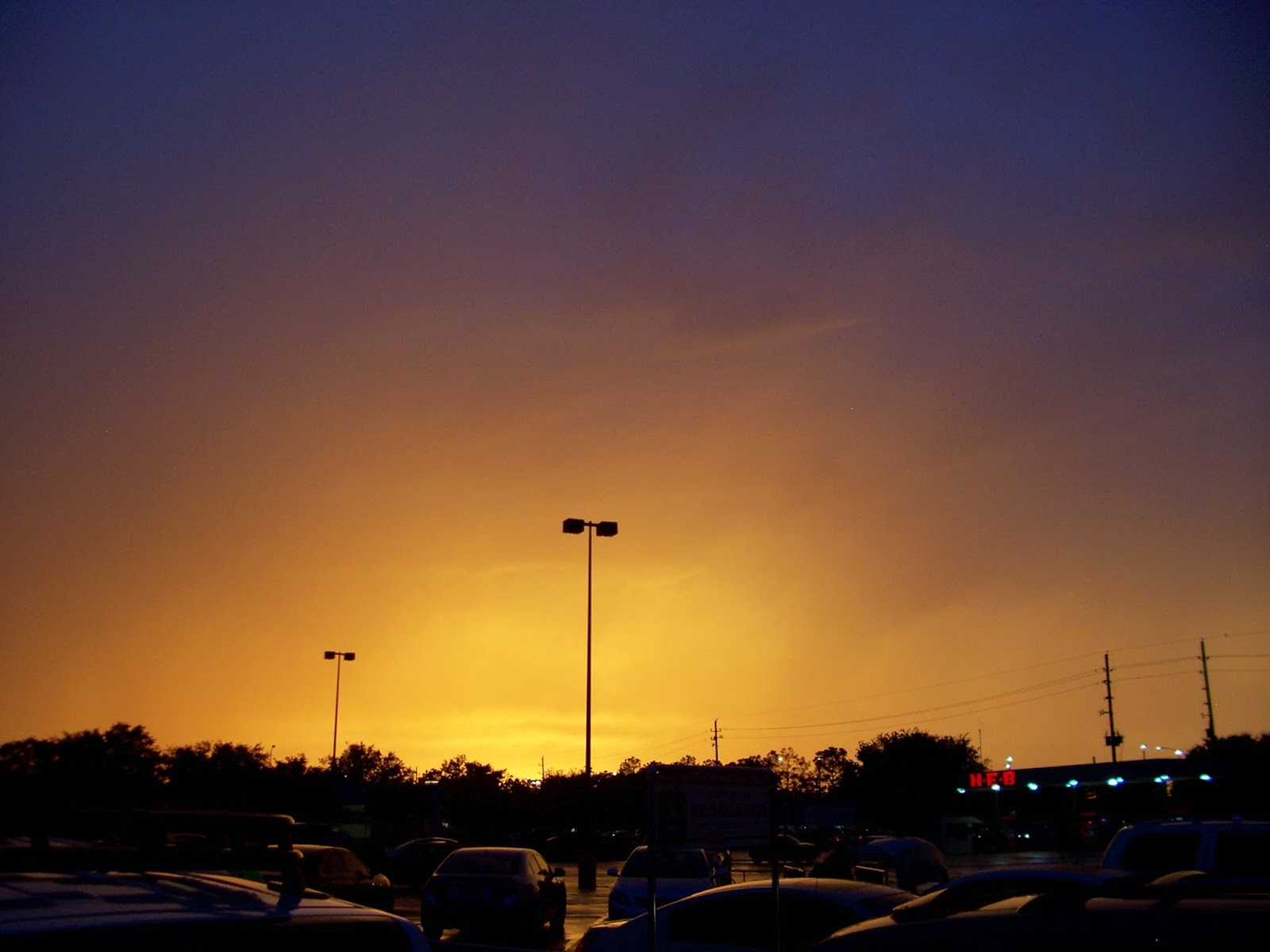
The sunset that I photographed from the grocery store parking lot is the most gorgeous one I've seen in a long time. If God doesn't mind hanging one of His colorful masterpieces over our cluttered man-made landscape, I sure don't mind taking a picture of it!
Friday, March 28, 2014
What You Aren't Being Told About Astronomy- Vol. II : My Thoughts
People will tell you that stars are so many millions or billions of light years away from the earth, and that is evidence that the Genesis record of creation can not be right. I'll grant that. But that is not the only evidence of the universe's history to be found in the stars. We need to look at the whole picture that science has drawn for us. It turns out that some astronomy data supports the creation model rather than the evolution model. I watched a DVD lecture from the Institute for Creation Research on this topic a little while ago. It's called What You Aren't Being Told About Astronomy- Vol. II.
He explains his points in simple, layman's language. If you're a 5th grader, or an adult who's not very scientifically-inclined, you'll be able to follow easily. It's not going to prepare you to have an intelligent conversation with an astrophysicist, but it might give you enough material to have a semi-intelligent conversation with another non-scientifically-inclined individual. What he had to say was encouraging to me, and I think other Christians who believe the historical record in the Bible would find it the same.
Here is a paraphrase of what he taught me.
Stars should not even exist. According to the evolutionary model of the origins of the universe, the Big Bang occurred when a tiny speck of extremely dense gas suddenly exploded. At first, the only thing in the universe was these gases, which later formed stars. There are two forces on gas molecules: gravity and gas pressure. Gas pressure disperses gas molecules, and in our scientific observation, gas pressure is always stronger than the gravity of gas molecules on each other. The only way to bring gas molecules together is to enclose them. Not many giant containers in space, are there?
There are five different theories that scientists have for the formation of stars. I can remember three right now...
Secular scientists now say that 96% of matter in the universe is either dark matter or dark energy. They don't know anything else about it, but they say that this unobservable stuff is responsible for the origin of stars.
There are not young galaxies where there should be. We are now able to look so deep into the universe with our telescopes that we can see galaxies that, according to the evolutionary model, we are observing as they were only 500 million years after the Big Bang. They are mature galaxies with many, many stars. The evolutionary model can hardly allow for more than a few stars to have formed by that time, much less entire galaxies. Even the galaxies that are a bit later, in the 3 to 6 billion year range, are too well-formed for their age.
Our sun is not a run-of-the-mill star; it is quite unique. It is in the 25% of stars that are NOT red dwarf stars. Red dwarf stars are smaller and much, much dimmer than the sun. The earth would need to orbit much more closely to the star, were it orbiting one of these, and only one side of the earth would face the star- all the time. Not good for life. Red dwarf stars have a lot of violent superflares; the sudden burst of heat would toast the earth in no time anyway.
Of the stars that are similar to the sun, most of them are in binary pairs or in a cluster of stars- again, not good for a planet's orbit. We have observed that stars in the same category as the sun have a superflare about once a century. Our sun is unusually stable and quiet. In addition, our sun's position in the galaxy protects it from drifting. If the chances of stars existing are basically null, then our star's odds are even less.
There is of course a Vol. I in this astronomy series, and I think they are working on a Vol. III. I hope to watch both sometime.
So evidence for the origins of the universe is conflicting. What are we supposed to make of that? It just means that there is more information left for us to uncover. We're misunderstanding something still- probably lots of things. Because we're just little people, and we haven't been studying this for very long. I for one am going to stick with the creation model, which has not only some scientific data but also a historical document on its side.
He explains his points in simple, layman's language. If you're a 5th grader, or an adult who's not very scientifically-inclined, you'll be able to follow easily. It's not going to prepare you to have an intelligent conversation with an astrophysicist, but it might give you enough material to have a semi-intelligent conversation with another non-scientifically-inclined individual. What he had to say was encouraging to me, and I think other Christians who believe the historical record in the Bible would find it the same.
Here is a paraphrase of what he taught me.
Stars should not even exist. According to the evolutionary model of the origins of the universe, the Big Bang occurred when a tiny speck of extremely dense gas suddenly exploded. At first, the only thing in the universe was these gases, which later formed stars. There are two forces on gas molecules: gravity and gas pressure. Gas pressure disperses gas molecules, and in our scientific observation, gas pressure is always stronger than the gravity of gas molecules on each other. The only way to bring gas molecules together is to enclose them. Not many giant containers in space, are there?
There are five different theories that scientists have for the formation of stars. I can remember three right now...
- Two stars collide.
- A supernova occurs.
- A black hole.
Secular scientists now say that 96% of matter in the universe is either dark matter or dark energy. They don't know anything else about it, but they say that this unobservable stuff is responsible for the origin of stars.
There are not young galaxies where there should be. We are now able to look so deep into the universe with our telescopes that we can see galaxies that, according to the evolutionary model, we are observing as they were only 500 million years after the Big Bang. They are mature galaxies with many, many stars. The evolutionary model can hardly allow for more than a few stars to have formed by that time, much less entire galaxies. Even the galaxies that are a bit later, in the 3 to 6 billion year range, are too well-formed for their age.
Our sun is not a run-of-the-mill star; it is quite unique. It is in the 25% of stars that are NOT red dwarf stars. Red dwarf stars are smaller and much, much dimmer than the sun. The earth would need to orbit much more closely to the star, were it orbiting one of these, and only one side of the earth would face the star- all the time. Not good for life. Red dwarf stars have a lot of violent superflares; the sudden burst of heat would toast the earth in no time anyway.
Of the stars that are similar to the sun, most of them are in binary pairs or in a cluster of stars- again, not good for a planet's orbit. We have observed that stars in the same category as the sun have a superflare about once a century. Our sun is unusually stable and quiet. In addition, our sun's position in the galaxy protects it from drifting. If the chances of stars existing are basically null, then our star's odds are even less.
There is of course a Vol. I in this astronomy series, and I think they are working on a Vol. III. I hope to watch both sometime.
So evidence for the origins of the universe is conflicting. What are we supposed to make of that? It just means that there is more information left for us to uncover. We're misunderstanding something still- probably lots of things. Because we're just little people, and we haven't been studying this for very long. I for one am going to stick with the creation model, which has not only some scientific data but also a historical document on its side.
Friday, February 7, 2014
National Bible Bee// Tennessee Trip 2013 Pt. II
Recap of our two day trips out to Smoky Mountain National Park:
We made an easy hike up to a waterfall. Wish I'd had the place to myself!
We saw lots of trees. That's a good thing!
We saw a bear!!! A living, breathing black bear!!!
We climbed up into a 150 year old hay loft.
We almost froze to death again! This was after church on Sunday, and the second trip up into the mountains was rather spontaneous, so I was still wearing what I'd worn to church. My sisters had the smarts to change clothes. It was 20 degrees, and I had bare legs. Hence, not many pictures of me in the frost. But it was celestial.
We stepped foot in North Carolina! Another state I can say I've been to!
Subscribe to:
Posts (Atom)